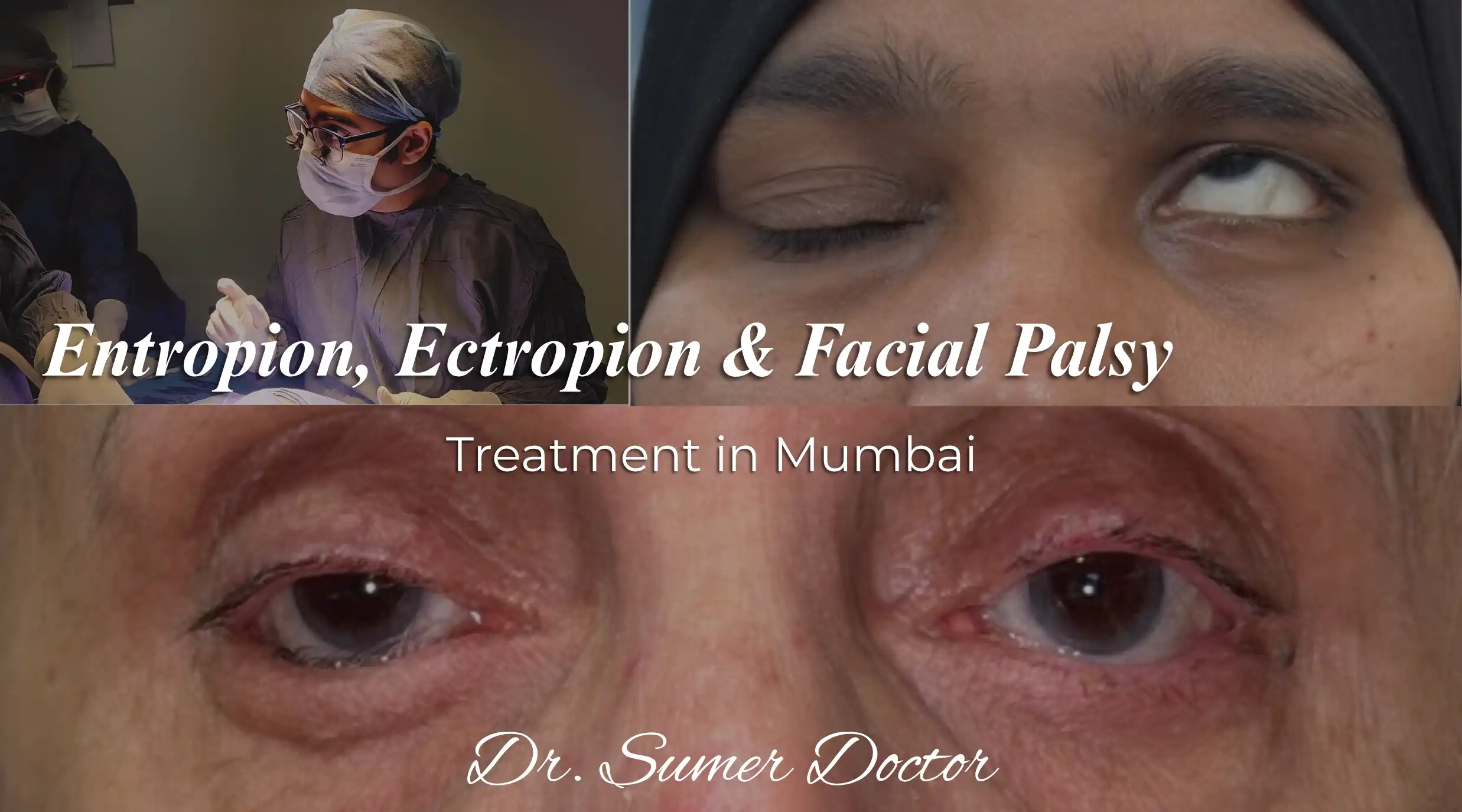
Entropion, Ectropion & Facial Palsy

https://drsumerdoctor.com/wp-content/uploads/2026/08/Banner-1.png

Introduction

Eyelids help they spread tears, sweep away dust, and shield the eye. When a lid turns inward, turns outward, or won’t close properly, that protection fails, and the eye becomes red, watery, gritty and painful.


Dr Sumer Doctor is an oculoplastic surgeon in Mumbai who has immense experience in eyelids that have lost their normal position or movement: entropion (turning in), ectropion (turning out), and the eyelid problems that follow facial palsy (an eye that cannot close). Most are corrected with quick, precise day-care surgery that restores comfort and protects your eyes.

Which Of These Is Happening To You?

  • My eyelid rolls inward and my lashes scratch my eye → Entropion

  • My lower lid sags outward and my eye waters → Ectropion

  • My eye won’t close fully — often after Bell’s palsy or facial weakness → Facial palsy

Entropion (the eyelid turns inward)

Why it happens: most often simple ageing, as the lower-lid tissues loosen. It can also follow scarring or rarely be by birth.

What you feel: a constant foreign-body or “grain of sand” sensation, redness, watering, and light sensitivity. It should not be left untreated.

How it’s corrected: a short day-care operation tightens and repositions the lid so it sits correctly and the lashes turn away from the eye.
Entropion, Ectropion & Facial Palsy2

Ectropion (the eyelid turns outward)

What it is: the lower lid droops and rolls away from the eye, leaving the inner surface exposed.

Why it happens: commonly ageing; facial palsy, skin shortening or scarring, or previous eyelid surgery.

What you feel: paradoxically, a watering eye since the tear drainage no longer meets the eye.

How it’s corrected: surgery tightens the lid back against the eye. Where the cause is tight or shortened skin, a small graft may be added to release it. Like entropion, it is a precise day-care procedure.

Entropion, Ectropion & Facial Palsy3

Facial palsy (the eye won’t close)

What it is: when the facial nerve is weak (most often after Bell’s palsy, also after infection, surgery, or trauma) – the eye cannot close fully, the lower lid sags, and the brow drops.

Why it matters: an eye that cannot close dries out and is exposed, which can damage the eye.

How it’s managed: When closure remains incomplete, a discreet weight implant in the lid helps it close, lid-tightening lifts the sagging lower lid, and other refinements restore both protection and symmetry.


Entropion, Ectropion & Facial Palsy5

What is Post-Surgery Recovery Like?

Days 1–3

Moderate swelling and bruising. Cold compresses and head elevation help.

Days 7-10

Sutures removed if required. Most bruising is now concealable

Weeks 6–12

Swelling settles fully; final eyelid position is achieved

Post-Care

Antibiotic ointment and lubricating drops for the first few weeks. Avoid swimming, gym and eye rubbing for 2 weeks. Reading and screens are fine within 1-2 days.

Review appointments at week 2 and week 6.

Post-Surgery

Protect Your Sight

An eyelid that turns in, turns out, or won’t close is not just irritating, it leaves your eye unprotected. If any of the above sounds like you begin a conversation by Whatsapping +919391521982 to know more.

cta-img

Eyelid Correction Surgery - FAQs

It is done under local anaesthesia, as a day-care procedure. Discomfort afterwards is mild.

Incisions sit in natural eyelid lines and settle to near-invisible.

Recurrence is uncommon after well-performed lid-tightening surgery.

Many cases (such as Bell’s palsy) improve with time. The priority meanwhile is protecting the eye so no lasting damage occurs during recovery.

Clinic Location

Well-connected and easy to reach by road, rail, and air.

Near metro station

Parking available

Accessible clinic

Get Directions